
EuroShop 2026 in Düsseldorf once again confirmed itself as the leading international event for the retail sector, attracting visitors from all over the world and offering a unique opportunity to explore the latest trends and innovations.
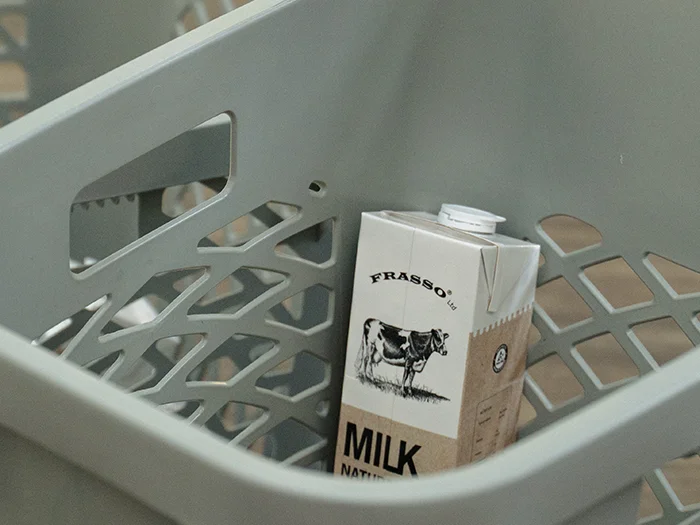
In this context, Plastimark showcased its most innovative solutions, including the range of shopping baskets made with the AluNova Eco-Compound, developed in collaboration with Tetra Pak.
Alongside these, the new 130 L modular full-plastic Luma trolley completed the offering of sustainable and high-performance products, drawing significant interest at the stand.
This participation highlighted how the retail market today is increasingly focused on solutions that are truly sustainable, measurable, and innovative, where design, functionality, and reduced environmental impact come together to create real value for brands, retailers, and consumers.
Materials as a strategic choice in sustainable design
In today’s retail sector, materials are no longer a simple technical choice, but a strategic design decision. Performance, durability, aesthetics, and environmental impact are now closely interconnected and decisive factors in the development of point-of-sale solutions.
It is within this context that AluNova was created: Plastimark’s Eco-Compound line developed to combine sustainability, material innovation, and high performance.
Why the collaboration with Tetra Pak is based on a shared vision
The collaboration with Tetra Pak is not exclusively industrial, but cultural and strategic. Both organizations share the belief that sustainability must be measurable, transparent, and embedded in production processes, rather than communicated as an abstract value.
The use of aluminum-polymer fraction recovered from beverage cartons recycling process makes it possible to convert this material into a high-value secondary raw material.
This circular economy approach underpins the development of all Plastimark Eco-Compounds, designed for durable, customizable retail applications and aligned with the principles of responsible design.
From material to project value
Considering materials as a strategic lever means integrating them from the very early stages of design. It is not simply about choosing a polymer, but about building a solution that takes into account:
• the entire product life cycle
• the supply chain
• the needs of brands, retailers, and end consumers
It is in this context that AluNova was developed, one of the Eco-Compound lines created by Plastimark: a family of materials designed to deliver high performance while reducing environmental impact, thanks to the use of raw materials derived from selected waste streams.
The key role of PCF in AluNova products
One of the central elements that makes AluNova a strategic choice is the PCF – Product Carbon Footprint. Measuring the carbon footprint allows for an objective and comparable assessment of the environmental impact associated with a material throughout its life cycle.
Thanks to the composition and origin of its raw materials, AluNova products feature a significantly reduced PCF compared to traditional solutions. This data becomes a concrete tool to support more informed design decisions, facilitate dialogue with international brands, and respond to growing demands for transparency and environmental responsibility.
Design, performance, and sustainability in retail
AluNova demonstrates that sustainability and performance are not conflicting concepts.
All shopping baskets in the Plastimark range are available in the AluNova Eco-Compound, ensuring the same levels of:
• mechanical strength
• aesthetics
• long-term durability
even in high-intensity retail environments, while reducing environmental impact.
The material thus becomes an integral part of the design language: not only a structural element, but also a narrative one, communicating a conscious, responsible, and future-oriented choice.
Materials as a driver of sustainable innovation
For Plastimark, designing means taking responsibility beyond the final product. It means selecting materials capable of generating a positive impact throughout the entire value chain, building partnerships based on shared goals, measurable data, and continuous innovation.
The collaboration with Tetra Pak and the development of the AluNova line represent a concrete example of how materials, when treated as a strategic design choice, can give shape to new solutions, new production models, and an increasingly sustainable vision of retail.
Learn more about the AluNova Eco-Compound
To explore the technical characteristics of the AluNova Eco-Compound in detail, visit the dedicated page:
https://plastimark.com/alunova-compound/
Here you can find full technical specifications, the complete list of products made with AluNova, the specific PCF values for each product, and an in-depth description of the material.
AluNova demonstrates that a conscious choice of materials used in everyday shopping products can generate real value, both today and in the long term.